
 |
 |
Food Plant: Prunus spinosa (Blackthorn)
Mine: June, possibly also August-September
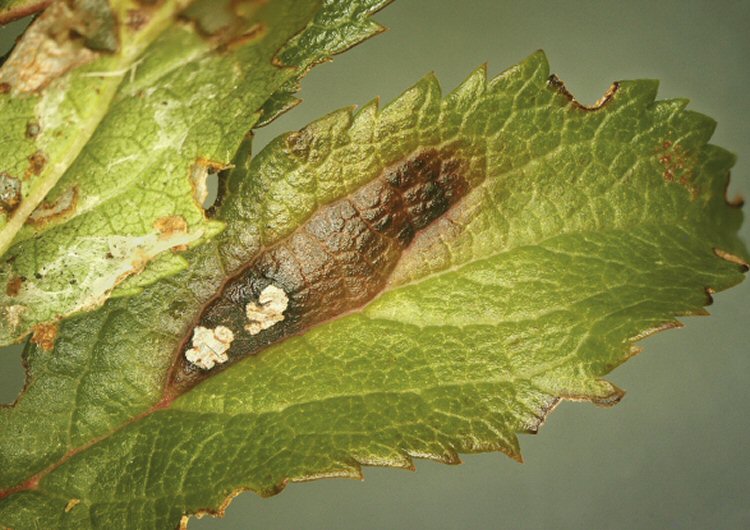
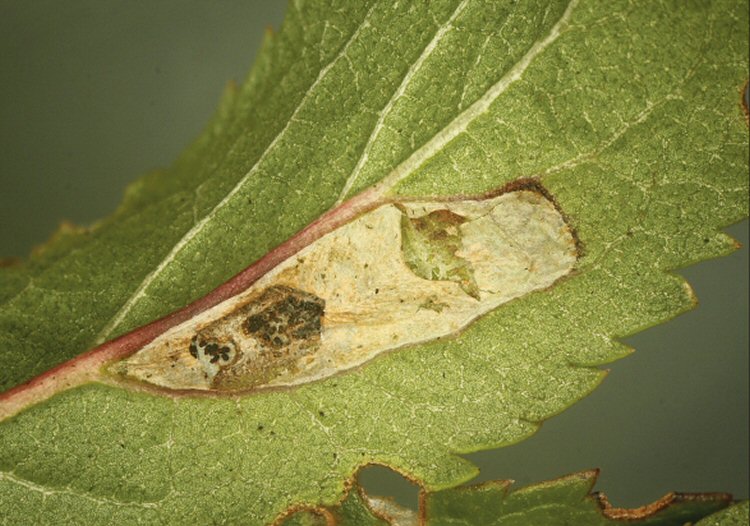
Notes: This is only known from Dungeness in Kent, feeding on the prostrate form of Prunus spinosa. The larval stages are described for the first time (Beavan, Heckford & Langdon (2026)). The larvae form upwardly spun leaves in later instars, which distinguish them from the downwardly spun leaves of P.finitimella and P.torquillella.The larva constructs a white flat silken spinning on the upper surface of a leaf, which extends throughout the leaf but not to its base. The silk then contracts and the leaf forms a tube or pod. Frass accumulates at the apex of this spinning, as the larva feeds on the upper parenchyma, turning the leaf brown where it has been feeding. The larva contructs a silken cocoon, in which it pupates. It is possible that the larva mines leaves in early instars, but this needs further investgation. A vacated mine, which is possibly this species is shown with the leaf remaining flat. If the mine was from another Parornix species on this host one would expect the leaf to be contracted downwards as the mine matures.
Data: 23.vii.2023, Dungeness, Kent, VC15
Image:© S.D. Beavan & R.J. Heckford
sponsored by Colin Plant Associates (UK) LLP/Consultant Entomologists