
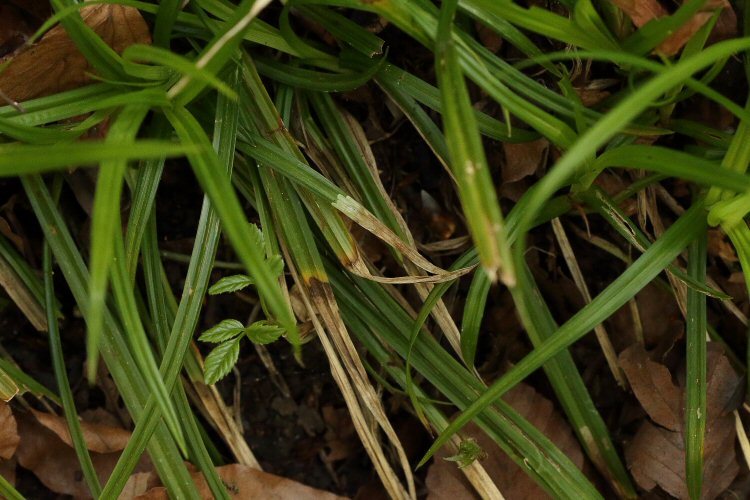
Food Plant: Carex spp: C.echinata (Star Sedge), C. flacca (Blue Sedge), C.laevigata (Smooth Sedge), C.paniculata (Greater tussock-sedge), C.pendula (Pendulous Sedge) ; Luzula pilosa (Hairy Woodrush), L.sylvatica (Great wood-rush)
Egg: laid under the tip of the leaf
Mine: September-May
Notes: Mines towards the base of the leaf, ultimately in a mine as broad as the leaf.The frass is deposited in large irregular islands.The larva is a whitish-grey and has a dark brown head and black prothoracic plate. If the leaf tip die-back in winter overtakes the mining larva it then moves to another leaf. A mine in spring in the field on Carex sylvatica. Mines at this time of year have lots of fresh, whitish damage, but earlier in the winter when larvae are feeding more slowly they are blacker and harder to detect. Adult reared.
Data: 01.v.2023, Aston Rowant NNR, Oxfordshire, VC23
Image:© WillLangdon
sponsored by Colin Plant Associates (UK) LLP/Consultant Entomologists